


Year-End Review: Could Your 2026 Campaigns Lead to a Professional Indemnity Claim?
As we wrap up another year, many companies are likely reviewing their activities.

The World Cup is back this summer, with football heading across the Atlantic from 11 June to 19 July 2026.
Huge events rely on people, premises, kit, contractors, travel, technology and contingency plans. If one thing goes wrong, the cost can climb quickly.
Small businesses may not be running a World Cup stadium, but many face similar risks on a smaller scale. Stolen tools. Damaged equipment. Missed deliveries. Flooded stock. Supplier problems. A key person off work.
Football has produced some strange insurance stories over the years, but behind the insured legs, stolen trophies and dogs saving the day, there are useful reminders for small businesses.

Kaka and Cristiano Ronaldo of Real Madrid enter the pitch before the La Liga match between Real Madrid and Deportivo La Coruna at the Santiago Bernabeu stadium on August 29, 2009 Madrid, Spain.
(Photo by Tsutomu Takasu) CC BY 2.0, via Wikimedia Commons.
When Real Madrid signed Cristiano Ronaldo in 2009, they were not just signing a footballer. They were signing goals, shirt sales, global attention, commercial value and a pair of legs carrying an alarming amount of responsibility.
Reports at the time said Real Madrid insured Ronaldo’s legs for around €100 million after his transfer from Manchester United. This sounds absurd until you remember the business model.
If a club’s income, performance and brand value rely heavily on one person’s ability to sprint, shoot and occasionally defy physics, those legs become more than legs. They become a business asset.
Most small businesses do not have anything quite as glamorous. However, they often have something vital they rely on, such as the van that gets a tradesperson to every job, the laptop that holds client work, the coffee machine that keeps the café moving, the booking system that keeps appointments flowing, the customer database or, importantly, the key staff who quietly know how everything works.
The most important asset is not always the one with the biggest price tag, but instead it is the one that would cause the most disruption if it suddenly became unavailable. When you think about your business insurance, think about not just “what do we own?” but “what do we depend on?”
Long before the World Cup trophy went missing, the FA Cup had its own vanishing act. In 1895, Aston Villa won the FA Cup and loaned the trophy to local boot and ball maker William Shillcock, who displayed it in his shop window in Birmingham. Then it was stolen.
The original trophy was never recovered, and years later, a man claimed it had been melted down and turned into half-crowns. Aston Villa were fined £25 to help pay for a replacement because the trophy had been lost while under their care.
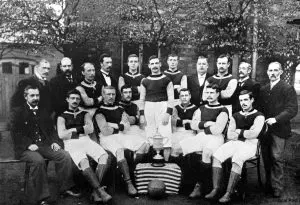
The Aston Villa 1895 FA Cup team, posing with the trophy.
(Photo by Henry Joseph Whitlock), Public domain, via Wikimedia Commons.
Small businesses often look after things they do not own. Customer goods, hired equipment, borrowed items, event equipment, samples, stock in transit, tools, laptops, items left for repair or goods being installed.
If something is lost, stolen or damaged while it is with you, ownership may not be the only issue. Responsibility matters too.
That is why it is worth checking how your insurance treats property in your care, custody or control. It is also worth checking contracts, hire agreements and customer terms before something goes missing.
“It wasn’t ours” does not always mean “it wasn’t our problem.”
During the Second World War, Derby County goalkeeper Ray Middleton reportedly faced a very practical problem. He was working as a miner, but his football career depended on his hands.
For most people, a finger injury would be painful and inconvenient. For a goalkeeper, it could be career-ending. So, according to reports, Middleton insured his fingers at Lloyd’s for £2,000 in case a mining injury stopped him from playing.
Small business owners also need to manage the risk of staff suffering from physical or mental health issues. Employers have a legal duty to manage health and safety in the workplace alongside a legal duty to manage work-related stress.
In addition, employers’ liability insurance is intended to protect a business where an employee brings a claim for injury or illness said to have arisen out of their work, and the employer is found legally liable, subject to the policy terms and conditions.
As the world comes together in football, we look forward to drama, excitement, emotion and risks. However, small business owners want to avoid this in their everyday lives, so it may be a good time to check whether your insurance still reflects how your business works today.
Most businesses do not need unusual insurance. They need suitable insurance. They need insurance that reflects what they do now, they need valuations that are up to date, and they need to understand what happens if key equipment is stolen, premises are damaged, stock is lost, a claim is made, or trading is disrupted.
FSB Insurance Service can help FSB members review their business insurance and understand where their current cover may need a closer look.
Call 020 3883 7976 to speak to our UK-based team.
This content is for general information only and is not intended to provide advice or a personal recommendation. Insurance cover is subject to the terms, conditions, and exclusions of the policy. Always consider your individual circumstances and seek professional advice before arranging insurance. External websites are not under our control and we are not responsible for their content.
Cover image Henry Joseph Whitlock, Public domain, via Wikimedia Commons
As we wrap up another year, many companies are likely reviewing their activities.

Use these ten simple questions to check whether your insurance still reflects your business.
An Employer Reference Number, or ERN, identifies your PAYE scheme.